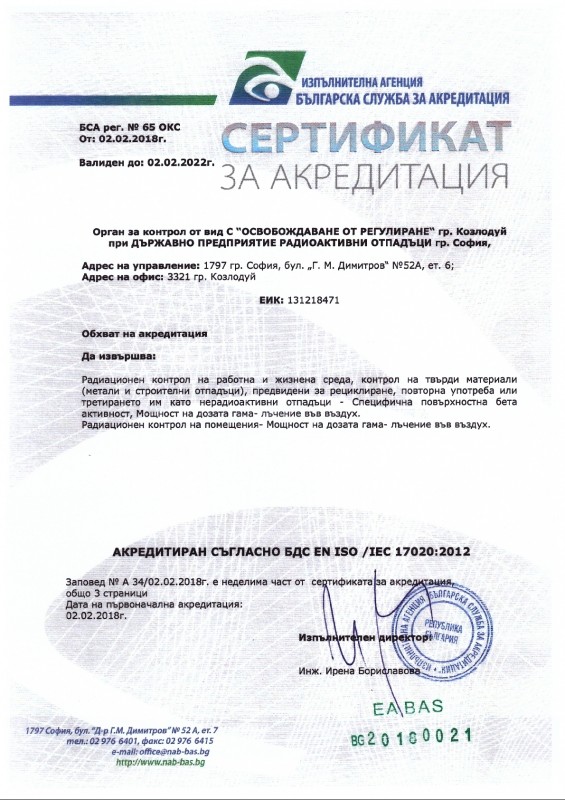
SERAW department obtained the right for final radiological assessment
16.03.2018After a complex and precise procedure, which has lasted for almost three years, the Bulgarian Accreditation Service (BAS) officially accredited a specialised department of State Enterprise Radioactive Waste (SERAW) – Inspection Body of Type C “FREE RELEASE”.
The role of the Inspection Body is to strictly observe and apply the Bulgarian materials control requirements – in terms of their radioactivity and safety in the case. In practice, once a material has been initially radiologically characterised, a competent authority shall then assess the compliance of the contamination levels in the test material with those stipulated by the legislation*. The assessment determines the final decision – whether this material should be classified as radioactive and subjected to subsequent management and storage or should be released from further control as completely safe.
In order to obtain the right to perform such a highly responsible function, the department has developed 14 different procedures in accordance with BDS EN ISO /IEC 17020:2012 **
All measuring equipment has been properly calibrated and passed the mandatory state metrological inspection.
The staff is trained and competent – it has undergone the necessary training, has been subject to supervision under real work conditions and has been accredited for the right to work independently in accordance with the inspection procedures. “There are 17 specialists in the team. In their work they are guided by the basic principles provided by Standard 17020 – confidentiality, impartiality and independence, for which they have signed a personal declaration. The members of the SERAW’s senior management are bound with the same declaration”, so informed Yancho Dimov, Head of the Inspection body of SERAW.
The department’s management system is in full compliance with the accreditation and provides 100% traceability of the entire process. In their work, the staff follows strictly the approved procedures. Their activity starts from the acceptance of an application form (made available to all other departments), a review of the information in it, carrying out the requested inspection, issuing an Inspection Certificate in accordance with the established results.
An application may also be submitted by an organization external to SERAW, both from Bulgaria and other countries – this right is defined by the accreditation definition of “type C”, as the standard is internationally recognised in the European Union and worldwide. There are only two or three Inspection Bodies in Bulgaria with similar accreditation for competence.
The establishment of a Free Release Body within SERAW was among the main priorities of the Enterprise’s Management during the entire accreditation procedure. Georgi Razlozhki, Deputy Executive Director in charge of the RAW management and Decommissioning, commented:
“The certification of such department has two major positive effects. First of all, we get much more flexibility and independence in the process of planning and implementing the decommissioning activities at Units 1-4, as the specialists, who have the right to determine the material streams – for storage or free release – are on site (so far they were experts travelling from around the country).
The pace of our work will greatly improve. Secondly, we will also achieve economic efficiency, as we will perform such a specific free release activity by our own efforts and not through external organisations. This saves money from the state funds through which the RAW management in Bulgaria is funded”.
The work of the Inspection Body “Free Release” within the SERAW will be under continuous monitoring performed by both the Accreditation Body BAS and the other regulatory bodies in the field of radiation protection – the Bulgarian Nuclear Regulatory Agency and the National Centre for Radiology and Radiation Protection.
………………………………………
* Regulation on Radiation Protection, 2018
** BDS EN ISO/IEC 17020 is an international harmonised standard that contains requirements for:
• Competence of the inspection bodies;
• Their impartiality;
• The consistency of their inspection activities.
This standard applies to Inspection Bodies of type A, B or C which are defined therein and applies to each stage of inspection.